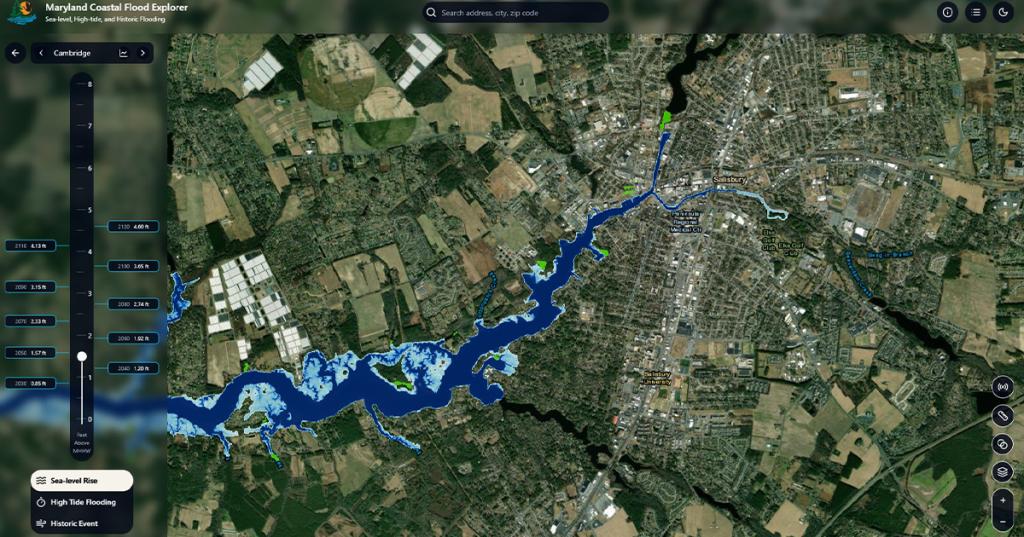
Coastal flooding is an increasing hazard for Maryland's coastal regions. In an effort to provide coastal communities and decision-makers equal access to high-quality and high-resolution data, the ESRGC recently partnered with the Maryland Department of Natural Resources and University of Maryland SeaGrant to develop a flood visualization tool designed for Maryland's unique vulnerability to flooding and sea level change. As technical partners on this project, the ESRGC provided sea level rise projection and data engineering expertise to guide project partners in decision making and focus group question development. The ESRGC also interviewed nine subject matter experts and developers of other flood visualization tools to learn about the needs of users and successes/challenges other developers experienced over time. One of the biggest takeaways from these discussions focused on the sustainability of the tool, mainly, what elements could be implemented now to avoid major rebuilds in the future. The ESRGC strongly advocated for the Maryland Coastal Flood Explorer to be a Maryland tool at its core, using sea level rise projections specific to Maryland, local LiDAR-derived products for depth grid development, and built-in functionality to add data layers from Maryland iMap. The sea level rise predictions developed and last released in 2023 by the University of Maryland Center for Environmental Science are local and current predictions specific to Maryland. The ESRGC designed and built the web interface using modern web standards, rigorously testing functionality and design to deliver a focused, reliable flood-visualization experience. The tool offers local planners access to data to support development and updates to hazard mitigation plans, comprehensive plans, and nuisance flood plans, while Maryland residents may explore the tool to better understand current and predicted future flooding in their community. Explore Maryland’s sea level change, high-tide flooding, and historic flooding at www.mdfloodexplorer.org. |